Tear Down and Rebuild or Renovate? How to Tell What the House Needs
Renovate when the bones are good. If the foundation, framing, and roof structure are sound, and the problems are finishes, layout in a few rooms, or a system or two at the end of its life, renovating usually makes sense. A teardown deserves a serious look when the structure, the systems, and the layout all need replacing at once. At that point you’d be paying to save very little, and you’d still be living with the old house’s footprint.
Most houses fall clearly on one side. Some sit in the middle, and those are the ones worth walking through with someone who builds both ways. This guide is part of our series on remodeling vs. new construction.
Signs a House Is Worth Renovating
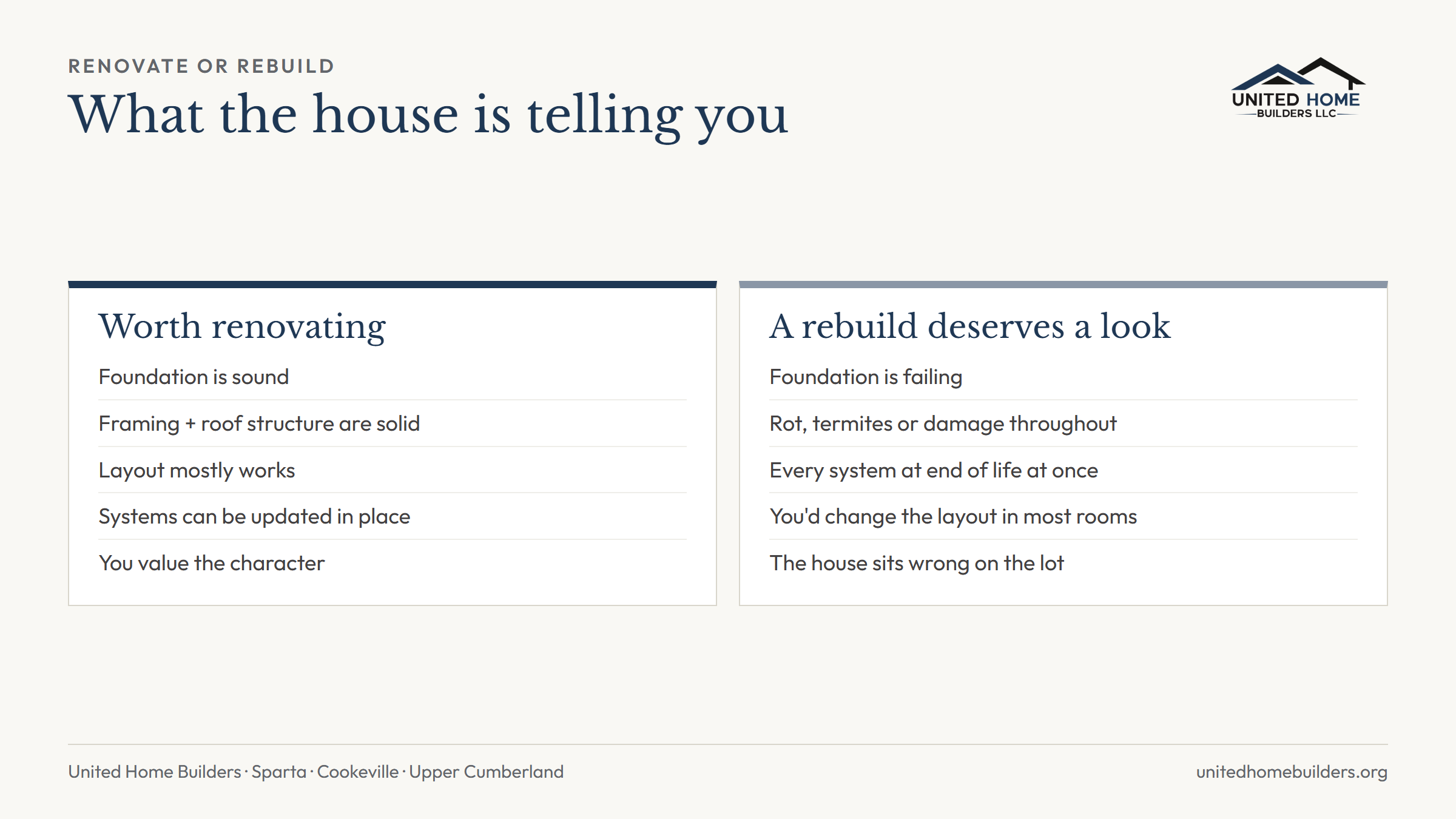
A house is usually a good renovation candidate when most of these are true:
- The foundation is sound. No major cracking, settling, or water problems that keep coming back.
- The framing and roof structure are solid. Some repair is normal. Widespread rot or termite damage isn’t.
- The layout mostly works. You want to open up a kitchen or add a bathroom, not move every wall in the house.
- The systems can be updated in place. Replacing an HVAC unit, a water heater, or a panel is ordinary remodeling work.
- You like the house’s character. Old brick, hardwood floors, a porch with a view. Some of that can’t be bought new at any price.
Older houses are the norm, not the exception. Harvard’s Joint Center for Housing Studies reports that the median American home was 44 years old in 2023, and that replacing worn-out roofs, windows, and HVAC systems made up 49% of homeowner improvement spending that year. An older house isn’t a reason to tear it down. It’s a reason to inspect it well.
Signs a Teardown Deserves a Serious Look
A rebuild starts to make sense when several of these show up together:
- The foundation is failing, and repairing it would cost a large share of what a new one would.
- Structural damage is widespread: rot, termites, or fire or water damage through much of the framing.
- Every major system is at the end of its life at the same time: wiring, plumbing, HVAC, roof, and windows.
- You’d change the layout in most rooms. Ceiling heights, room sizes, and the flow of the house all need to be different.
- The house sits wrong on the lot. It’s in a spot that floods, it blocks the best view, or it leaves no room for the garage or addition you need.
No single item on that list decides it. A sound house with old wiring is a renovation. A house with a failing foundation, rotten framing, and a layout you’d gut anyway is a different conversation.
What a Teardown Costs That a Renovation Doesn’t
Tearing down has costs of its own, and they come before the new house starts:
- Demolition and debris removal, including hauling and disposal.
- Testing before anything comes down. The EPA recommends that a trained, accredited professional sample suspect materials, and that removal be done only by an accredited asbestos professional. Homes built before 1978 also carry lead paint rules for paid work.
- Disconnecting and reconnecting utilities.
- New permits for a new house. In Putnam County, for example, the county’s building codes office lists a septic permit from the state, a building permit, and plumbing and mechanical permits, followed by inspections in order.
- Septic changes. If the new house has more bedrooms or more fixtures, the existing septic system may not be enough. Tennessee treats added wastewater flow as a modification or expansion of the existing system, with its own permit and fee.
- A place to live for the whole build. NAHB economist Na Zhao found that contractor-built homes took about 12 months from permit to completion in 2024.
What You Give Up When You Tear Down
A rebuild solves a lot, but it isn’t free of trade-offs:
- Where the old house sits. An older house may sit closer to a road or property line than current rules would let a new one. Check with your county before assuming a new house can go in the same spot.
- Materials you can’t replace. Old-growth lumber, reclaimed brick, original woodwork.
- Trees near the footprint. Equipment and new foundations can damage roots that took decades to grow.
- Living on the property. A renovation can often be phased around you. A teardown can’t.
The Middle Paths Between the Two
It isn’t always all or nothing. Some of the best projects we see sit in between:
- A gut renovation. Strip the house to the studs, keep the foundation and shell, and rebuild everything inside. You get new systems and a new layout inside the existing footprint.
- Keep part, replace part. Keep the sound portion of the house and replace the wing that’s failing, or build an addition while renovating the original.
- Renovate now, add on later. Fix what’s urgent now, and plan the addition for when the budget allows.
Our guide to what each word means explains how these scopes differ, and our cost guide covers how to compare the numbers.
How We’d Walk the House With You
Our process starts with Discover: the house, the land, your priorities, and your budget. On a renovate-or-rebuild question, that means looking at the foundation, the framing, the roof, and the systems before anyone draws a plan. Rick Conley spent 26 years running a masonry company, so foundations and brick get a close look.
From there, Plan turns the answer into a scope and a preliminary estimate, and Build carries it out. We handle both remodeling and additions and new construction, so we can tell you honestly which one your house needs.
We work in Sparta, Cookeville, Crossville, Livingston, Monterey, Smithville, McMinnville, Gainesboro, and the towns around them. Tell us what you’re working with, and choose Other / Not Sure Yet on the form if you haven’t decided.