Remodeling vs. New Construction: The Pros and Cons of Each, and How to Decide
Should you remodel the home you have or build a new one? Neither answer is right for everyone. Remodeling usually makes more sense when you like where you live, the house is structurally sound, and the problem is space or layout. Building new usually makes more sense when the house is fighting you on structure, systems, and layout all at once, or when the location itself no longer fits.
United Home Builders does both. We build custom homes and barndominiums across Sparta, Cookeville, and the Upper Cumberland, and we remodel and add on to homes in the same towns. We don’t have a side to sell you. This guide lays out the honest pros and cons of each path, with numbers from the people who track the housing industry, and links to four deeper guides on the questions homeowners ask us most.
The Case for Remodeling
Remodeling lets you keep what’s already working. That’s the whole argument, and it’s a strong one.
The advantages:
- You keep your location. Your land, your neighbors, your church, your school zone, and your drive to work all stay the same.
- You keep what’s already paid for. The foundation, the roof structure, the driveway, the well or water tap, the septic system, and the mature trees don’t have to be bought again.
- You can phase it. A kitchen this year and an addition in three years is a real plan. A new house is one big commitment.
- People are happy with the results. In the 2025 Remodeling Impact Report from the National Association of Realtors and NARI, 64% of homeowners said they wanted to spend more time at home after their project was finished.
The drawbacks:
- Older houses hide things. Harvard’s Joint Center for Housing Studies reports that the median age of an American home reached 44 years in 2023, the oldest it has ever been. Opening a wall in an older house can turn up rot, outdated wiring, or framing that doesn’t meet today’s code.
- Pre-1978 homes need lead-safe work. The EPA requires that anyone paid to disturb paint in a home built before 1978 be certified in lead-safe work practices. That’s real, but it’s planning, not a deal-breaker.
- You may live through it. Dust, noise, and a kitchen that’s out of commission for weeks are part of most remodels.
- You’re working inside an existing frame. The footprint, ceiling heights, rooflines, and foundation set limits on what the new space can be.
- Remodeling doesn’t always pay back at resale. In the 2025 Cost vs Value report, a midrange bathroom addition averaged $60,645 nationally and returned about 53% of that cost in resale value. That’s fine if you’re staying. It matters if you might sell soon.
The Case for Building New
Building new gives you a house designed around the way you live now. It also asks more of you up front.
The advantages:
- Design freedom. Single-story living, a primary suite on the main floor, a mudroom where you actually come in, a shop for the trucks and the tools. You start from your list, not the last owner’s.
- Everything is new. The structure, the roof, the windows, the HVAC, the plumbing, and the wiring all start their lives on the same day, built to current code.
- Fewer surprises once you’re out of the ground. Most of the unknowns on a new build are in the site work. Once the foundation is in, the rest is far more predictable than opening the walls of an older house.
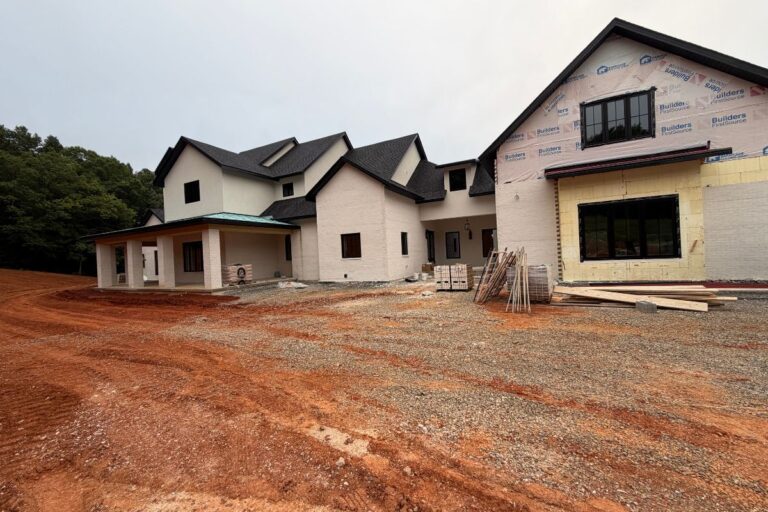
- Land is part of the appeal here. In the Upper Cumberland, building new often means building on acreage, with room for a garage, a pole barn, or a barndominium. Our new construction page covers what we build.
The drawbacks:
- Land and site work cost real money. In the National Association of Home Builders’ 2024 cost survey, the finished lot made up 13.7% of the average new home’s sales price. Building on raw land means paying for clearing, grading, a driveway, utilities, and often a well and septic system.
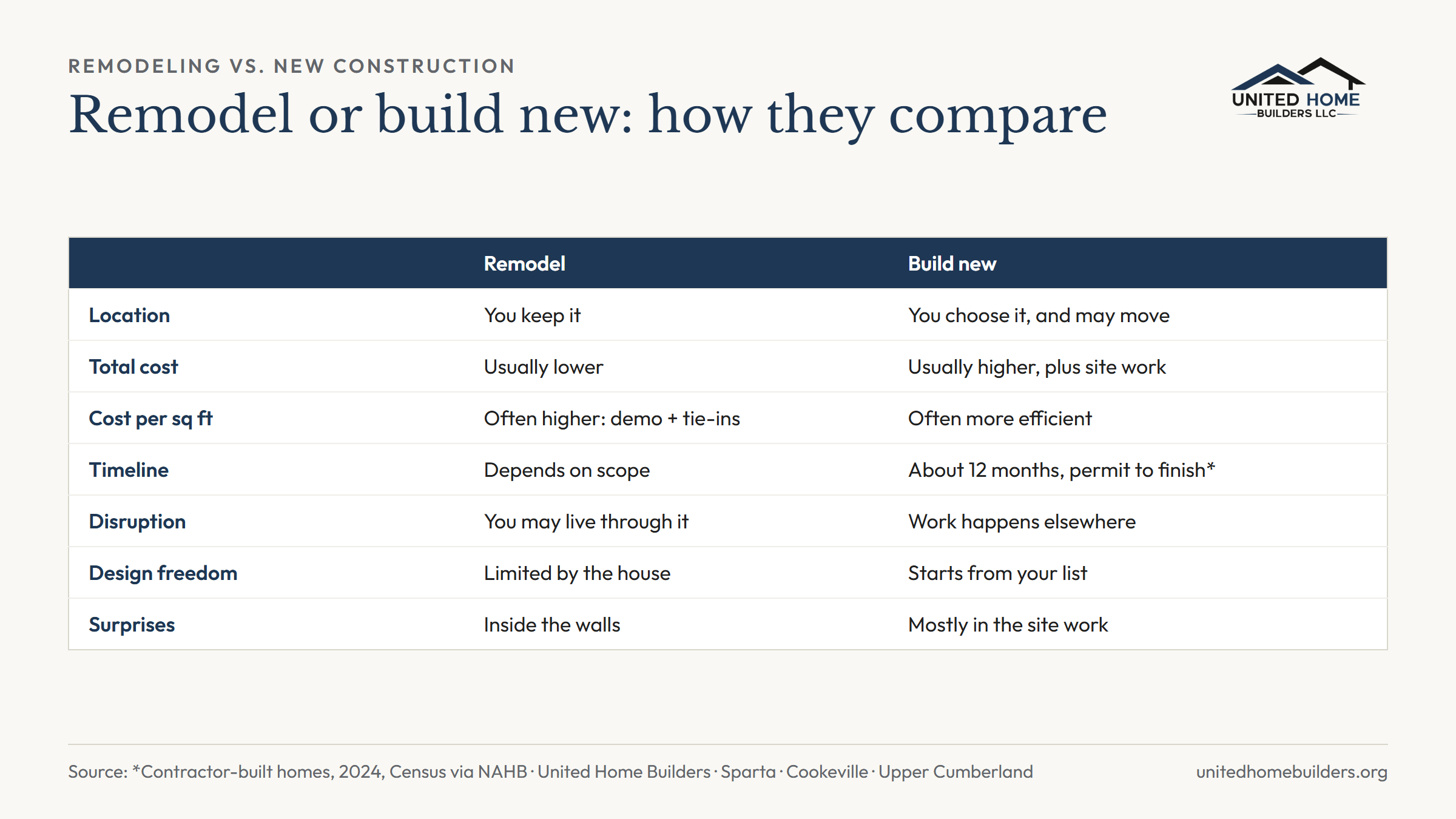
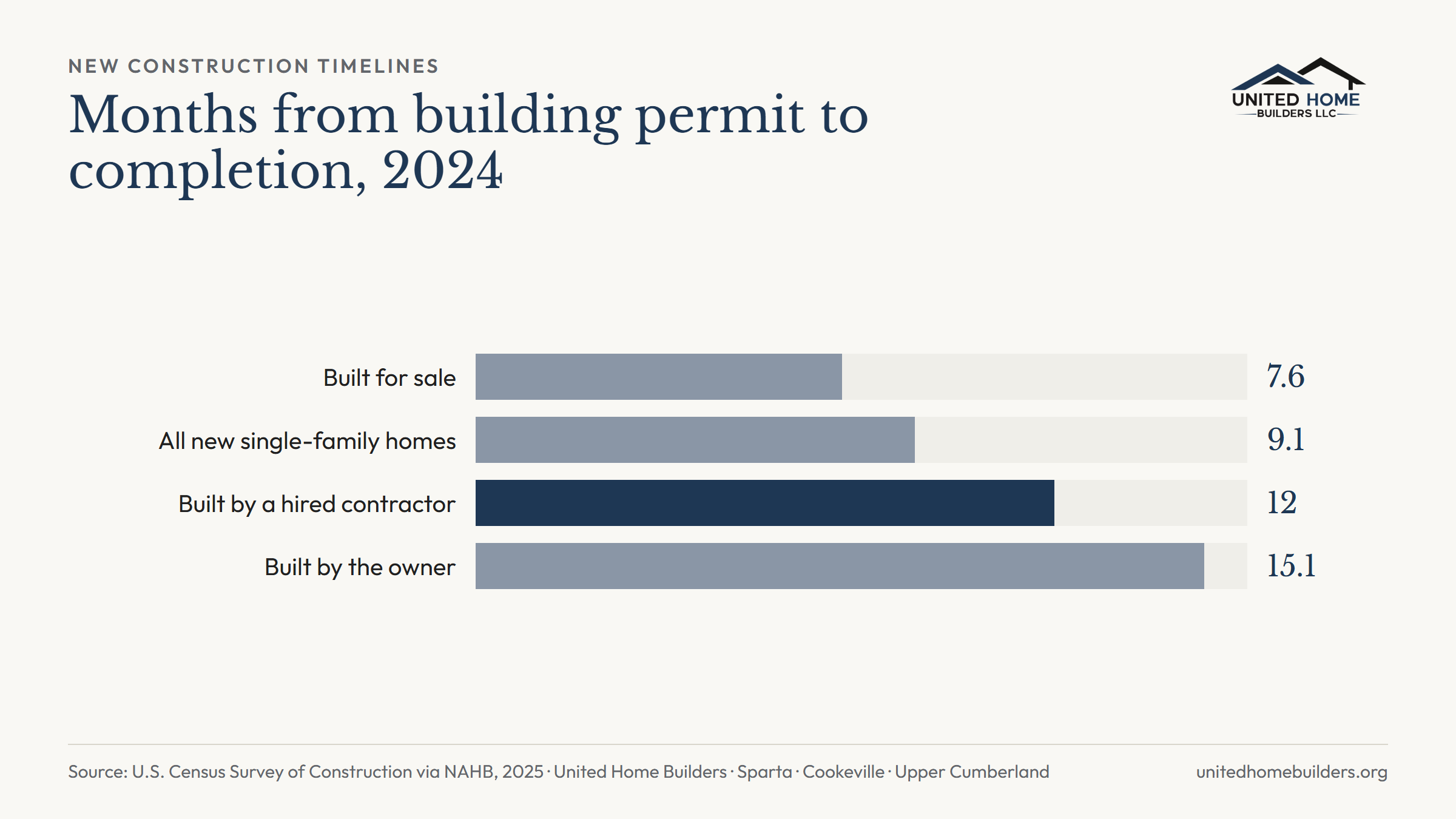
- It takes longer than most people expect. NAHB economist Na Zhao, working from Census data, found that homes built by hired contractors took about 12 months from permit to completion in 2024.
- Hundreds of decisions. Plans, siding, roofing, cabinets, counters, flooring, fixtures, lighting. Some people love that. Some people don’t.
- If you’re moving, it’s two transactions. Selling one house and building another means overlapping costs and, for a while, two of everything.
Six Questions That Usually Settle It
Most homeowners we talk with can sort this out with six questions. You don’t need perfect answers, just honest ones.
1. Do you still love the location?
If the answer is yes, that’s the strongest argument for remodeling. You can change almost anything about a house. You can’t change where it sits.
2. Are the bones good?
Foundation, framing, and roof structure. If those are sound, almost any remodel is on the table. If they’re failing, the conversation shifts toward a rebuild.
3. How much of the house would you change?
One or two rooms is a remodel. Most of the rooms, plus the layout, plus the systems, starts to look like a rebuild with an old house in the way.
4. Can the lot and the systems carry what you want?
An addition with new bedrooms can put more load on a septic system. Tennessee’s rules treat changes that add wastewater flow as a modification or expansion of the existing system, with its own permit. Setbacks, slope, and the electrical panel matter too.
5. How long can you live with the disruption?
A remodel brings the construction to you. A new build keeps it somewhere else, but it takes longer to finish.
6. What is the real budget on both sides?
Count what it would cost to move, not only what it would cost to build. Count what you’d spend living through a remodel, not only the contract price.
Is It Cheaper to Build or Remodel a House?
Remodeling usually costs less in total dollars, because you’re changing part of a house instead of building all of one. Per square foot, though, remodels and additions often cost as much as new construction or more, because of demolition, tie-ins, and the surprises inside old walls. Our full guide breaks down where the money goes on each side and the costs people forget to count.
Read more: Is It Cheaper to Build or Remodel a House?
Tear Down and Rebuild or Renovate? How to Tell What the House Needs
Some houses are worth saving and some aren’t. Renovating makes sense when the structure is sound and the problems are cosmetic, functional, or limited to a few systems. A teardown deserves a serious look when the foundation, framing, systems, and layout all need replacing at once, because at that point you’d be paying to save very little.
Read more: Tear Down and Rebuild or Renovate?
Remodel or Move? How to Weigh a New Home Against the One You Have
If the location still fits and the fix is space or layout, remodeling is usually the simpler path. If the location no longer fits, no remodel will solve it, and the choice becomes buying an existing home or building a new one. Your mortgage rate belongs in the math too.
Read more: Remodel or Move?
Remodel, Renovate, or Rebuild: What Each Word Means for Your Project
People use these words loosely, and contractors don’t always mean the same thing by them. Renovating updates what’s there. Remodeling changes how the space works. Rebuilding replaces the structure. The word matters less than the scope, because scope is what drives permits, price, and schedule.
Read more: Remodel, Renovate, or Rebuild?
Where to Start If You’re Still Undecided
Start with a walk-through, not a floor plan. Our process runs Discover → Plan → Build, and the Discover step is where this question gets answered: what you need, what the house and the land can handle, and what each path would really involve.
Our owners have spent a long time on both sides of this work. Mike Dalton brings 35 years of leadership, project management, and logistics, starting with 20 years in the U.S. Army. Rick Conley has 32 years in construction, 26 of them running his own masonry company. You can read more about our team, see our remodeling and additions work, or browse all of our services.
We work in Sparta, Cookeville, Crossville, Livingston, Monterey, Smithville, McMinnville, Gainesboro, and the towns around them. When you’re ready, start with a conversation. On the contact form, choose Other / Not Sure Yet as the service type, and tell us what you’re weighing.